
|

|

|

|

|

|

|

|

|

|

|

|

|

|

|

|

|

|

PETER PRENDERGAST

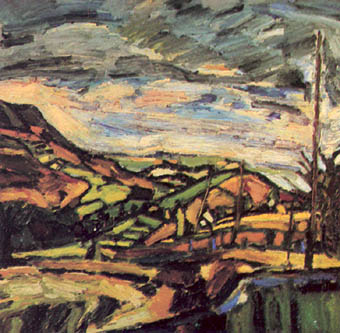
LANDSCAPE NEAR BETHESDA
1973 oils
Peter Prendergast was brought up in Abertridwr, near Caerphilly in South Wales where his father was a miner. His approach to landscape painting was determined there in his earliest drawings, and he remembers particularly the teaching of Gomer Lewis. At the Slade School he was influenced by the teaching of Frank Auerbach which was based on a direct visual approach, learned through experience and industry, rather than theory. There are few landscape paintings that survive from his two years at Reading, due to his inability to come to terms with the landscape though he spent much of his time working from the figure. In 1970 he moved to Bethesda; the village is perhaps the one in the whole of North Wales most like the South Wales valleys, in the evident industrial wasteland, the appearance of the domestic buildings and the narrow valley.
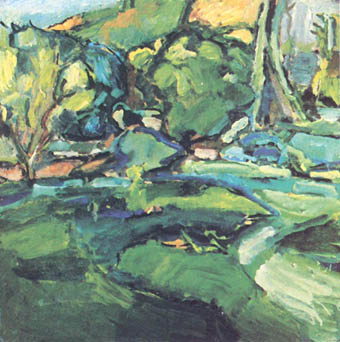
GARDEN AT LLYS MEURIG
1980 oils
The huge Penrhyn Slate Quarry is entered from Bethesda, and Prendergast became intrigued by the view into its pit from the edge of the man-made cliff. He did not make this the subject of a series of works of equal importance, but made drawings and sketches as studies for larger works, which came to have almost the significance of history paintings. Some sketches were themselves increased in size by strips added around their edges, usually maintaining a square format. The intention remains to work these into a final painting on a grand scale, which summarised the history of the quarry as a record of years of human labour.
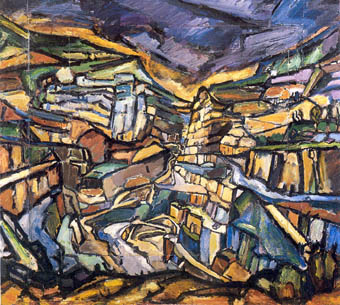
BETHESDA QUARRY
1978/81 oils
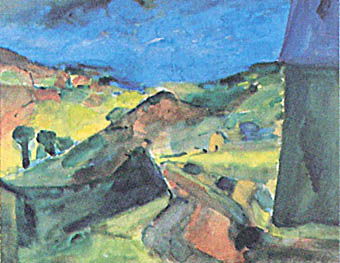
ROAD FROM THE STUDIO, PARC
1975 watercolour
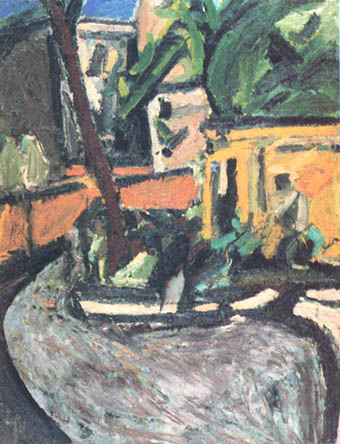
CARTWRIGHT GARDENS
1967 oils
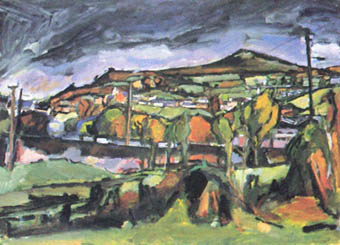
ROAD TO BETHESDA ON AN AUTUMN DAY
1978/81 oils
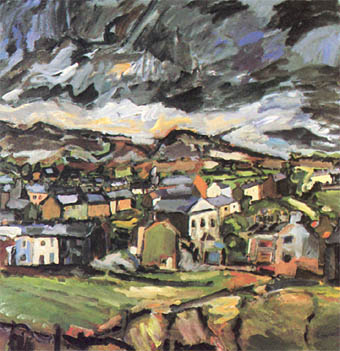
CARNEDDI ON A SUMMER DAY
1978 acrylic
GO HERE
FOR AN ARTICLE WRITEN IN 1982 BY MERETE BATES