|
|
|
PETER PRENDERGAST
IT IS THE paralysing custom
in our culture to put the artist on a pedestal, to single him or her out as a rare if not unique soul, hypersensitive to such vague qualities as beauty and sublimity and dwelling in some empyrean realm quite remote and detached from ourselves. To enhance this feeling of awe, if not worship, we take their work from the paint-spattered bed-room and child-worn house where it probably originated and space it out in pristine white-washed halls. We use long, obscure words in official missives to provide a sort of breathy incantation while we file round and stare, albeit sometimes in sceptical or hurt bewilderment.
|
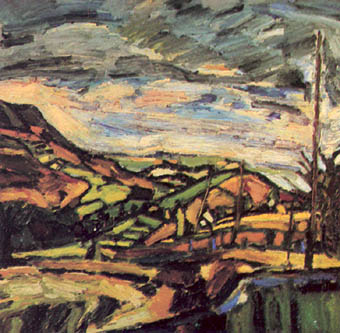
LANDSCAPE NEAR BETHESDA
1973 oils
|
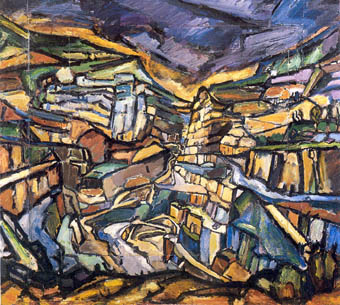 BETHESDA QUARRY
1978/81 oils
|
It would be easy to put Peter Prendergast on such a pedestal, to label him the new brutalist, savage expressionist, Boreas of Bethesda. But, even draped in sack-cloth, it would destroy him. It is because he is not a God, not even in some areas what is commonly described as talented, that he has most meaning for us. Born into a very ordinary family, growing up in mundane, hard and at times humiliating circumstances, he has never moved from the thick of life and its everyday problems. He has experienced, only too closely, the harsh divisions in our society but, far from submitting, he has fought through his painting to will sense and splendour from what is commonly rejected as failure - he has fought for unity. It is because he is the same, not different, that what he does has meaning for us. Put him on a pedestal and, as with a woman, we evade what he says. ’At the Slade, it was put to us: if we had a choice between saving a cat or a Rembrandt from a fire, which would we choose? I said the cat, of course. I think they were disappointed'. Prendergast's philosophy of art is not that far removed from D.H. Lawrence's "The droppings after the goats have passed". Prendergast may not be so irreverent, but for him, it is life that is most important. It is a matter of chance whether good art erupts from that life, or not.
It may be chance. But it is even more graft, effort, will. It is impossible to visit Peter, to stand slightly bent in the attic where he paints, to churn through sheet after sheet, canvas after canvas of flailing, lacerating line, of daubing, vibrating colour without acknowledging the stubbornness of his attack, the consistency of his style and themes. It has often been implied that his work too closely parallels that of his mentor, Auerbach, at the Slade. This is misleading, if not inaccurate. It was more a matter of Auerbach's stance confirming the direction that Peter had already taken. Early studies, long before he arrived in London, such as that of the Abertridwr pit-heads in heavy, black line and blue gouache are clearly identifiable with recent work such as Trees or Path of 1980. Indeed, Prendergast's work is as remarkable for its consistency as for its quantity. Considering the media-saturated ambience of the twentieth century, it is surprising how few, not how many extraneous influences can be detected in his work.
likes to deal with the material close around him. But his method of work, his interpretation struggle constantly against tradition, to feel and see not so much in an original as in a radical way. Thus, he rejects any habitual procedure in his work: 'This is always bothering me. If I'm not careful, I may come to rely on formulas'. Thus a drawing may be sparsely linear such as Head of June or it may be ground into blackness such as Quarry, evening. There is no reliance on academic technique, no neat selection of line, shape or tone that will satisfy him.
It is only necessary to compare Prendergast's work with that of his near contemporary, David Hockney (e.g. the portrait of Mr and Mrs Clark and Percy in the Tate Gallery) to realise that he is after something completely different, something more than 'an effect that will look clever or respectable' (however tempting for his prestige), more than a proper, finished picture.
It is a matter of a definition of aim. 'There are enough pretty portraits', he says, with no small amount of scorn. Or landscapes, for that matter. So he deliberately refuses to begin a painting with certain pre-conceived effects, there is no selected composition, no finished picture in view. It is much more a matter of infinite exploration, like a man striding round a mountain. And, before he starts, he does not know how or even if he will finish. 'I try to work to a logical process. But I can't, I'm affected by the weather, how I feel. Chance, accident always plays a part.' At an initial glance, a composition may seem awkward. Why is he showing all those backs of houses or why does that great lump of hill bulge up one side? But, after a while the awkwardness is seen as honesty. The composition is unpredictable, vital, introduces a dimension beyond the confinement of the frame.
In fact, Prendergast wants to penetrate beyond the static, surface appearance to incorporate change and conflict, to demonstrate a living interchange. Above all, he wants to embody qualities that are positive in himself with those he sees before his eyes. So, although his themes are apparently traditional, they are also, incontrovertibly contemporary. They are the record of a personal struggle, obliterating and re-shaping, hewing and blitzing, between a man and his life rather than any simple, representational record.
His life has been untypical only in that he has experienced both sides of the division in our society between success and rejection. 'Keep to the basics', Peter Prendergast repeats. He means facts that are bald and not always self-congratulary. His background is only too characteristic of the threadbare grind for life that permeates Welsh history. 'My father could find no work in Ireland. As a boy, he came to Maesteg in South Wales and went down the pit. He was a miner all his life. He'd complain of back-ache but otherwise we never spoke about it. It was only later, when often he felt so ill that he didn't want to go to work that we realised how much he hated it. But my mother packed him off, just the same'.
If a man spends his life in a dark hole, he prefers his sons to live in the light. There were three boys in the family. Two of them were very bright academically. They went to the Grammar School and one continued to the University. But Peter went to the secondary modern. Even today, it is not difficult to sense his early despair. 'At first I was hopeless, I believed there was no way I could be good at anything, noway I could pass any exams. I think my parents had given me up. I was afraid that I'd end up in a factory, or down a mine.' Both hung over his childhood, like the hell they are.
But one day, almost by accident, the art master mentioned to Peter's brother (' . . . not even to me, that is!') that Peter had a definite talent for colour, that his drawing could do with improvement but that there was hope that he might, possibly, get into an art college.
'Suddenly everything clicked - it all fitted in. I'd always loved painting. As a small child, I'd loved it. Later at school, if the teacher would draw me the outline of an angel, I'd be happy for hours just filling the wings in with gold. Then I'd want another outline. At fourteen, I began trying to copy Cezanne's Card-players. The teacher, who was something of a spiritual leader himself, showed me Rouault. I was awe-struck. Everything lit up. Then I realised that perhaps I could do art. Moreover, it might even get me a degree. In the worldly sense, I didn't have to be a failure'.
Painting promised success, it could pave the streets with gold or at least with a monthly salary rather than a weekly wage. And as a student, he was more than successful: Cardiff College of Art was followed by the Slade and Reading University. But Peter Prendergast was too broad, too honest and perhaps, in the end, too proud a man to allow the end to dictate the means. He was marked too deeply by his early experience of hardship, of rejection in society to be able to change. He was unable to abandon one part of himself (and hence of his family, of humanity) as worthless. He knew otherwise and his demand for unity, wholeness and fulfilment gradually and inevitably shaped certain priorities, certain choices as he built his life and work.
The twentieth century painter faces dilemmas not always apparent among his predecessors. The more problematical, perhaps, is the constantly re-iterated distinction between work acknowledged as of an international school - and the rest. Giotto, Rembrandt, Cezanne could evolve from their roots, could paint their native background knowing their work had universal value. Today a particular, inherited place and style can mean far less than adherence to a common, international movement. An abstract expressionist, a pop artist, a minimalist may spring almost regardless from New York, London, Paris or Tokyo. A more individual painter may trudge along for years, even for ever, unacknowledged. Although recently the exclusive absolutism of this attitude has been somewhat redressed - indeed, it is almost in favour "to do your own thing", it can still be a definite disadvantage for an artist to live, for example, in Bethesda rather than Berlin.
Peter Prendergast is only too acutely aware of his situation. Indeed the issues gnaw at his being like the tides at a breakwater. Yet, while he asserts: 'You can't go back to the impressionists, to being faithful to nature. It's a fool's paradise. You can't ignore abstract painting-the international movements of the past fifty years . . .', he deliberately chooses to leave London and return to Wales. He buys a small, stone house half-way up a mountain in Bethesda, a valley village much like Abertridwr, where he was brought up, except that the rock is scarred by slate quarries rather than pierced by coal-mines. It is an isolated community, far from affluent, where the artist is still regarded as something of a freak, if not to be ashamed of- particularly a poor artist.
As if aesthetic quandaries were not enough, economically the twentieth century artist is almost certainly a disaster. Patrons and private incomes are fewer and further between. No art student automatically expects to make a normal living out of their work, Far from it: they don't usually expect to make any money at all. As art staff are cut down, as more and more art colleges are amalgamated with polytechnics, as fine art departments are gradually whittled away or subordinated to industrial design (as threatened at the Royal College) or even totally closed (as was attempted at Liverpool recently) it is only too evident that, whereas technologists are necessary, artists are a nuisance. Potential painters are lucky to find teaching or even wholly unconnected jobs to support themselves while painting. But marriage, even more children, can force hard, potentially unhappy choices. Either the artist takes a full-time job and stops painting, or the family suffers.
Yet Peter Prendergast married young. He may wryly recall: 'She brought me great, fat tubes of paint when I was broke. That couldn't be all bad could it?' But his prosaic appreciation is misleading. He would not have married an acolyte. His sense of Justice, of vitality was not prepared to cramp either his own or his partner's fulfilment. They wanted children. They have four. It is far from easy. The family is in and out of debt. Energy drains into endless subterfuges. They move from a bigger to a smaller house. They let the house for bed and breakfast and all pile into a caravan in the garden. Yet, somehow, Peter Prendergast has broken through the taboos and survived. He persists with painting: the family thrives - just about, and because of their nature, their faith, not the conditions.
'I always work as near to home as I can. I can't see the point of cycling fifty miles to find a subject', Peter remarks. But it isn't so much that there is no point for him in cycling fifty miles, as that he has to live with his subject day in, day out. He has to attempt a face, a row of houses or trees, a quarry many times, on occasion perhaps tiredly, half-heartedly, on occasion freshly and full of vigour, before his purpose begins to materialise - before finally and wholly he pulls all the elements of himself and his subjects together,
Closer examination of the work shows that there are successive periods, often spanning as long as four or five years, during which a number of lesser studies of a subject gradually culminate in a few, or perhaps only one outstanding painting. There are the early life-studies that lead to the succinct and gripping portraits of Mrs Knipe. Even by I 970, he had found a way to pare out all but the most essential, expressive elements of a portrait. We see no details of hair, skin, clothing. Instead we see a hard, almost rugged body and a head full of patience, endurance resisting pain.
Then there are the robust street and tree studies done while teaching at Liverpool, the organic growth bursting through the bricks and concrete. There are the tumultuous views of Bethesda, of houses tumbling among mountains or just of tumbling mountains, as in View from Bethesda I 975. There are the surging greens and blues of foliage and grass as in Trees 1980, the careful, contrasting self-portraits. Last, but not least, there are the exhaustive quarry studies in which Prendergast focuses not on figures or landscape, but the endless struggle between them. 'There's two hundred years of work in Penrhyn quarry. It had to mean something.' There is sadness, as hangs over the quarry itself today, but there is also defiance in his tone.
To grasp the nature and full extent of Prendergast's achievement through the years, it is essential to understand the duality, if not contradiction of his aim which makes a fully resolved composition extremely difficult. As he has noticed himself: 'When I am drawing, I am dictated to by the subject. When I use colour, it becomes something else'. The division, in fact, is perhaps most clearly realised by a separate examination of his drawing and his painting.
As a child, his art teacher remarked that Peter's drawing could do with improvement. It is impossible to know quite what he meant by this since definitions of drawing are infinite. But, for Prendergast today drawing is 'measuring, something considered and worked out, not an emotional blitz'. He describes the process: 'I force myself to sit down and analyse. Some days I am cool, calm and collected, others I am tempestuous'. It is clear from his description that he is describing an intellectual process, an attempt to record the objective relationships of what he sees.
But his drawings reveal a much more complex process, certainly a conflict between putting down what he sees and his full, emotional awareness. In a few drawings, particularly of such subjects as furniture, where he works from the head alone, there is suddenly a dull, uncharacteristic pedantry. Others, such as Family with its big, protective hands and tiny head on shoulder, or Self portrait 1981 with its slight, hunched desperation, where fingers seem to be clamped in the anguish of trying to sense what to put down, communicate because of their lack of facility, their bare objectivity.
There is a need for a very delicate balance. And, very slowly through the years, veering first -in one direction then the other, Prendergast has striven to bring intellect and emotion together. He describes his attempts in the quarry:'! went again and again to one spot. I kept trying to draw it but I couldn't make it work spatially. The truth was I had to get back, to draw the whole quarry. It took me three years to realise.' The final Study for quarry painting I 980, a little worn, with rectangles of paper added as the scope extended, is one of his finest works. The artist's hard, graphite point stubbornly and austerely chips out an image, following the quarrymen's laborious galleries which, after infinite sweat and pain, barely erode the natural mountain of slate and granite. This is a great drawing, the more so for its economy, patience and humility. Its difficulty forced intellect and emotion together,
Prendergast's paintings always have more confidence, more lyrical exuberance than his drawings. He is at home in colour, in the dull resonance of flesh and earth hues or the shimmering emerald and cerulean, the glow of purple and scarlet. But a painting has a structure.
And here his problem has been to increase the complexity of the movement without losing the flow. Again it is struggle between head and heart. At times, his views of Bethesda become incredibly intricate yet almost fall apart into squares of houses between patches of green and blue. At others the composition almost melts away into a passionate welter of colour, as in Trees. Sometimes the structure, sometimes the flow is dominant as Prendergast develops the force of his images.
Finally, he brings the two elements into balance together.’I got to the state of using any colour as long as it worked compositionally' - he describes his magnificent oil Bethesda quarry. This is a driving, contrapuntal fugue of a painting, in which green and blue, rust and gold hues climb the canvas in an impetuous paean of joy. There is a need to tell the truth but, as the Welsh surely know, there is as great a need to sing.
Merete Bates 1982
|
|
|
|

|
|