|
Keith Bayliss
|
|
|
|
REVIEW OF THE WORK OF
KEITH BAYLISS

by
Malcolm Parr
Baudelaire wrote of truly imaginative artists that "nature is nothing but a dictionary. There one looks up the meaning of words, the formation of words; here one finds all the elements that make up a phrase or a story, but no one has ever viewed a dictionary in the practical sense of the word. Painters who follow their imagination look in their dictionary for the elements that match their idea; by adapting them with a certain art they give them an entirely new look. Those who have no imagination copy the dictionary.
|
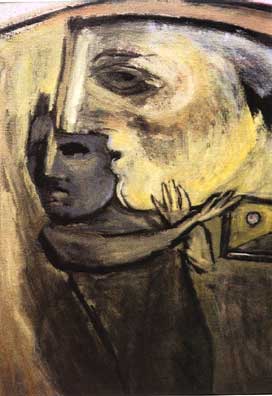
Keith Bayliss threw the dictionary away years ago. When he had his first one-man show in Swansea in 1980 he was praised for his strong, confident stylised line drawings (usually portraits) in pencil or ink, with the occasional use of watercolour. Some of these were extremely delicate and sensitive and sold well. Since then something has happened, something disturbing which, admittedly, had subtly suggested itself already at the first exhibition. Pandora has opened the box sufficiently wide to let out cruelty, satire, grotesqueness, mystery - all there suggested through the human figure (male and female, hermaphrodite) hideously distorted, jagged, foetal, mutilated, often locked in hieratic gestures of daunting ferocity.
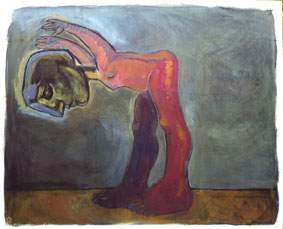
Now it is in oils that Bayliss has put his energy to devastate the mind and assault the complacency of the casual spectator. Creatures (inhuman? sub-human? non-human?) cavort and gesticulate obscenely in an unearthly light. Surely, these exist only deep in the human mind and not in the concrete world, which makes them all the more sinister. Sometimes single figures (profile or full-frontal), sometimes double figures (side by side, or above and below). Perhaps these double figure paintings are the most unnerving. Is it confrontation, aggression, violence, destruction that they represent? Tranquillity is banished. Nothing is explicit, everything has to be striven for. In this way Keith Bayliss draws the spectator into the world of his work. Involvement is the key word. Often he refuses to put titles to his paintings because he believes that by doing so he would be pointing his ideal spectator in a direction which he should be able to find for himself.
A monolithic culture is no longer possible, and, so, eclecticism is, maybe, the most satisfactory manner of representing our fragmented experience of existence. It therefore seems appropriate that a modern artist should wind us up in these different ways."
Malcolm Parr.
|



 KEITH BAYLISS 2

