






|
SALOME
"All art constantly aspires towards the condition of music".
Walter Pater.
THIS painting, which
Janes once referred to as a key work in his career (it dates from 1938), is one of haunting originality. It is the kind of work that needs intense scrutiny to be fully appreciated.
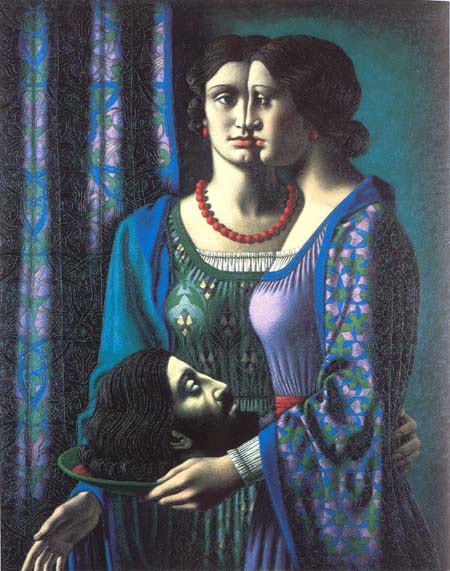
What strikes one at first is the representation of the faces of the three protagonists - three faces but only three eyes, and only one staring at the spectator. The moment is frozen, the dreadful deed is done, the mother, Herodias, has had her revenge. Salome (not named in the New Testament gospels) has accomplished what her mother requested her to do. The grisly trophy that Salome bears on the dish represents the mother's triumph.
The picture is a masterpiece of artistic organisation. Everything combines to effect a totality of impression. The faces of the mother and the daughter join, interlock ingeniously, suggesting the conspiring together of the forces of evil. Yet it is not simply the faces that meet in evil collusion but also the bosoms and the waists, the hair and the necklines. Echoes reverberate in sinister fashion throughout the picture. The sightless eyeballs of John the Baptist appear to be directed upwards to Salome's face whose gaze is averted. The splash of red on the dish, suggesting the blood shed in the decapitation, is echoed in Salome's waistband, the earrings and the lips of the mother and the daughter, and the line of the mother's necklace - the last to remind us of how John was put to death. But the head, the head - it all comes back to the head of the murdered man. A close examination of the picture reveals the artist's intricate, meticulous treatment of the tragic theme. In the mathematical precision of the painting of the clothes and curtains is represented the detailed, repeated pattern of the severed head. The tiny outlined profile of John's head even appears on the point on Herodias's breast where her nipple would be, the symbol of maternity become a weapon of murderous revenge. What images Janes might have created with Lady Macbeth!
The hard-edged geometrical treatment is reminiscent of early pre-Raphaelitism but by the time he was twenty-seven Janes was casting no nostalgic backward glances. It is well known that he became restless and dissatisfied with the attitudes and teachings at the Royal Academy Schools and
was excited more by what he could see in the galleries of nearby Cork St, especially the works of Picasso, Braque and Klee. What gives Janes's work it's power is his wide-angled vision and masterly technique. At the heart of his work is the constant search, a perpetual experimenting which persisted throughout his long and active life. This picture with its recurring motifs and its rich colour, its jewel-like texture, suggests a cold cruelty, oriental yet universal. Janes, as articulate in writing and in music as in paint and pencil, has created an artefact exact and exacting, original in technique and conception.
Imagination, Baudelaire maintained, is "the queen of all our faculties," and "is both analysis and synthesis... It is sensitivity... In the beginning of the world it created analogy and metaphor". Baudelaire is also careful to emphasise the claims of craftsmanship. "The person endowed with nothing but skill is a fool, and the imagination that tries to dispense with skill is nothing but insane."
This picture, Salome, in its beautifully complex composition, demonstrates perfectly the truth of Baudelaire's statement. And it was Janes himself who defined his approach to his work with these words: "I concentrate on craft, and if what comes out is art, that's a bonus"
MALCOM PARR
(This article was originally published in the catalogue for
'The Alfred Janes exhibition, a retrospective 1999'
at the
Glynn Vivian
Gallery, Swansea)
SALOME can be seen at CYFARTHFA CASTLE MUSEUM & ART GALLERY, Merthyr Tydfil
|
|
|