
- ESSAY


|
|
||

|
|||

|
|||

|
|||

|
|||

|
|||

|
|||

|
|||

|
|||

|
|||

|
|||

|
|||

|
|||

|
|||

|
|||

|
|||

|
|||
|
The application of identity as an 'unfixed' and 'unstable' state within visual arts. Nigel Williams BA(Hons) PGCE(FE) Identity as an 'unfixed' and 'unstable' state.
There are a number of complex theories which centre upon questions of identity. There are many issues that need to be considered when discussing this complicated area of study. I propose to examine some of these issues of identity with the support of the work of several artists whom I feel, at least in some part, directly or otherwise, deal with identity as an influence within their work.
William James, in his book "Principles of Psychology" (1890), also recognised this need to adapt to circumstances. He said "A man has as many social selves as there are individuals who recognise him and carry an image of him in their minds". For example, many people combine the life of a student, a parent and an employee at the same time. Subtle and not so subtle variations of identity may well be called upon for each of these roles. (2) It would be perhaps wise to attempt to illuminate the difference between identity and personality at this stage. Woodward is keen to point out the often held misconception that personality and identity are one and the same. Personality is a construct of traits, often common to many other people, for example - shy, timid, violent, or self confident. However, identity is perhaps best explained as providing "a link between individuals and the world in which they live," this is the process of association that seems to be central to many of the arguments. (3) Charles Cooley (1902) and George H. Mead (1934) both also agreed with the theory of interaction and attributed the 'self' as being mainly a social construct. William James had also acknowledged this, to some extent, in his theory concerning the 'Me' and 'I', in which the 'Me' is the part of our identity that we wish to show to others whilst he still believed there to be another uncontrollable influence within us which he called the 'I'. James saw the 'I' as the central core of our person. Cooley was perhaps ahead of his time with his "Looking Glass" theory of 'self', whereby he said the self is a reflection, largely from the minds of others. This therefore also being recognition of the social interaction of the process of association. (4) Erikson (1968) defined this process further by suggesting that that association occurs from a young age and continues throughout our development into adulthood. He claimed that identity formation "arises from the selective repudiation and mutual assimilation of childhood identifications" (5) Erikson continued to argue that 'children at different stages of their development identify with those part aspects of people by which they themselves are most immediately affected'. They consciously take what they need and discard what they don't. (6) Indeed, from the moment we are born we are categorised as either male or female and cultural specific sets of roles are enforced to ensure a child follows the accepted norms. But complex gender issues find a way to usurp and revise these carefully constructed role models. Judith Butler does not underestimate the importance of gender within our psyche and suggests that we should consider gender issues before embarking upon any other consideration of identity. (7) So we can see that our environment plays a vital part in our early development, but as we and grow and gain experience of other environments our earliest sources of reference are amended. What was once acceptable may no longer be so. Gender identity is also be affected by this process of evolution. Freud also suggested that gender relates to a child's self-categorisation, primarily by identifying with others perceived to be the same - physically. But Freud related these issues of categorisation to the recognition of a physical 'lack' and that "a girl's gender was significantly formed by the absence of a penis." (8) Freud failed to truly recognise that being a man or a woman is not a fixed state and that "It is a condition actively under construction." (9) Connell argues that none of us are actually born as what we know to be a man or a woman. Connell claims that we also acquire these labels through our associations. We now have the technological ability to physically alter our sex to suit our sense of identity. Although this is often seen as being outside the norms of society, this is not as unusual as it first may seem. In nature, sexual reproduction does not always depend upon physical specialisation between sexes. The humble earthworm is an example of a hermaphrodite, able to perform both roles of male and female quite adequately. (10) The earthworm may not make a conscious decision to become one or the other of the sexes it contains, but neither does it 'lack' either in its reproduction function. So, arguments based upon anatomical differences can be problematic. Genetic composition may well determine the sex of a person, but chromosomal differences can equally create dilemmas.
Our physical appearance changes with time. If we flick through family photograph albums we can get a shocking insight to this process. However, these images are simply representations of a body at a single time and place. They cannot possibly be an insight to the identity of the person captured within the photograph, in the same way that fleeting encounters are just a single impression in place and time. They cannot give us the complete picture of the individual. If we were to take a photograph of ourselves each year and then studied them in our old age we would be presented with a large collection of differing images, much like the self portraits painted by Rembrandt during his lifetime. Like our appearance, our experience changes with time. With time our knowledge expands and our occupations may change as a result. So which, if any, of the photos within the album is our true identity? (14)
Since the invention of film, and especially television, society has gained easy access to images of people from different social backgrounds and offers identification with a world beyond the reach of the majority of people.
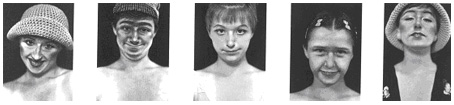
The five images (Fig i above) all feature Cindy Sherman. Each could simply be a snap shot of someone from our own family, or a still from a film. The lack of a title doesn't help us decide how to identify with any of the images. Even though we may be aware that they all feature the same person, not one of the images tells us anything about the identity of that person, beyond the stereotypical considerations.
Many artists also constantly struggle with issues of professional identity. A trawl through most retrospective exhibitions will often illustrate the metamorphosis of this identity. David Hockney, for example, has maintained strong political and social views throughout his life, but within his work we can see a number of changes that have had a dramatic influence upon his perception as a leading international figure. One of these changes can be traced to his enrolment to the Royal College of Art in 1959. This three-year post graduate course in painting exposed the artist to new influences, and this was reflected when he played down his earlier concerns with social realism and began to explore the realms of abstract painting, influenced by the works of Jackson Pollock, Alan Davie and Roger Hilton. (16)
Artists approach the issues of identity in many ways. The eccentric duo Gilbert and George have openly explored a wide range of identity issues, whilst artist Rachel Whiteread addresses them almost subliminally within her explorations of space.
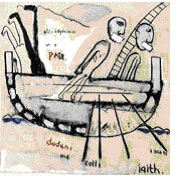
Welsh contemporary artist Iwan Bala struggles to resolve his understanding of these issues within twenty-first century Wales. Bala sees the role of artists in Wales as that of custodians of a cultural aesthetic. Whether there is evidence to support the premise that a 'Welsh aesthetic' ever existed is debatable, but Bala's work calls upon Celtic mythology to reinforce his place within the evolution of Wales towards a recognisable national identity, wrapped within the resurgence of the Welsh language. (21)
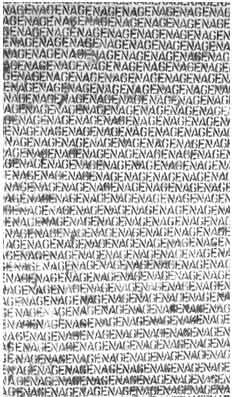
Tim Davies, another contemporary Welsh artist, calls upon political and other social and historical events to understand his place within a larger national identity. Although firmly anchored to a specific time and place, Davies' work also has an international message, beyond categorical placement. Davies is aware of the need for nations to face up to the process of evolution, due to geographical and economic shifts, but is also acutely aware of the "gulf between disposable and unobtainable wealth", which is often laid bare as a result of this assimilation. (22)
But, of course, no nation can be populated by a race of single cultural influence. Modern society within Britain has to balance the needs of a multi cultural influence. Other nations have had to deal with the displacement of the aboriginal people as a result of unwelcome immigration. Australian artist Gordon Bennett has struggled with his identity in a country that has, until recently, stubbornly refused to accept responsibility for the cultural decimation of the aboriginal people. Bennett is an extremely thoughtful and philosophical artist with an urgent mission to understand both his own identity and that of the new Australia. Born of an Australian aboriginal mother, with a Scottish father, Bennett experienced the turmoil of failing to identify with either race of his heritage. He felt pulled between two extreme poles and found his art to be the only means to reconcile the issues of identity he faced. Bennett draws from Minimalism, De Stijl and Abstract Expressionism, forcing features of these movements into a context of human relations that is at once global and national. Bennett deals with postcolonial theory, attempting reconcile the post-modern country of today far removed from the horrors of the colonial past.
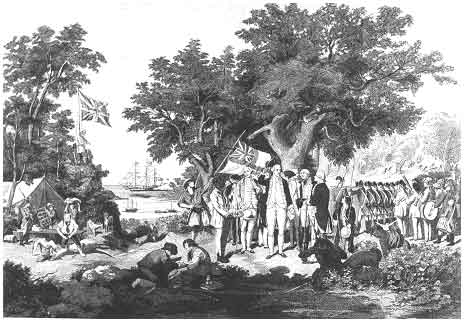
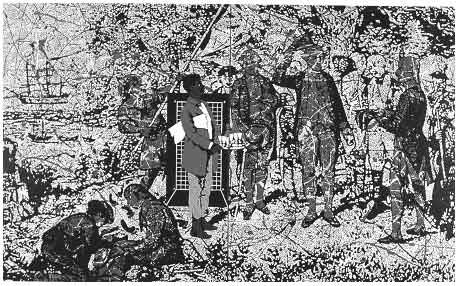
In this image (Fig iv, above) we see the romantic image of the great explorer Captain Cook being greeted by an aboriginal man-servant, carrying a tray of refreshments. The scene of settlers going about their business of survival detracts somewhat from the lines of soldiers in the background. However, in Bennett's version of the image the artist attempts to re-appropriate the scene on behalf of the native people. Using the original painting as a basis for his own, Bennett paints the scene using the spots of colour commonly associated with aboriginal painting. He emphasises the role of the black servant by painting him clearly. Bennett has used this method of representation frequently and is not afraid to portray the horrors of rape and murder that accompanied colonisation.
Nicholas Thomas, in his book "Possessions, Indigenous Art / Colonial Culture" suggests that Bennett "has something in common with the vandal who defaces the monument, but goes beyond mere decapitation or graffiti to suggest a reconstitution of national narrative, albeit one inescapably defined by pain, violence and contradiction." (23)
REFERENCES
BILIOGRAPHY
Alston. A. et al, Process - Explorations of the Work of Tim Davies ( Seren: 2002). Butler. J., Gender Trouble (London: Routledge, 1990). Bala. I., Certain Welsh Artists - Custodial Aesthetics (Seren: 1999). Connell. R.W., Gender (London: Blackwell, 2002). Cruz. A. et al, Cindy Sherman - Retrospective (London: Thames & Hudson, 1997). Davies. J., A History of Wales (London: Penguin Books, 1990). Eysenck. M.W., Individual Differences (Hove: LEA, 1994). Gross. R. et al, Challenges in Psychology (London: Hodder & Stoughton, 1997). Jahn. W., The Art of Gilbert and George (London: Thames & Hudson, 1989). Krauss. R. et al, Rachel Whiteread - Shedding Life (Liverpool: Tate Gallery, 1993). Lingwood. J., Rachel Whiteread - House (London: Phaidon, 1995). Malim. T. & Birch. A., Introductory Psychology (Macmillan Press, 1998). Melia. P., David Hockney (Manchester University Press, 1995). Thomas. N., Possessions - Indigenous Art / Colonial Culture (London: Thames & Hudson, 1999). Verma. G.K. & Bagley. C., Race, Education and Identity (London: Macmillan Press, 1979).
Woodward. K. "Questioning Identity: Gender, Class, Nation", London: Routledge (2000).
|